See whether AI recommends your brand. And what to fix if it does not.
AnswerTrace asks the questions your buyers ask on ChatGPT, Google AI, Perplexity and Claude, shows how often you get named and who gets named instead, then writes the pages that change it.
Free scan, no credit card. Score ready in minutes.
See a sample reportYour customers ask AI engines in every market you sell in.
AI gives them three or four brand names. If yours is not one of them, you never see the sale you lost.
What a scan does, in four steps.
The four screens below show each step on a real sample brand. Click a step to jump to it.
AnswerTrace asks the questions your buyers ask, across ChatGPT, Google AI, Perplexity and Claude.
02One score, then the detail: where you are named, who is named instead, by engine, language and place.
03The fixes come ranked by impact, with the page drafted for you on Growth and up.
04After each fix goes live, the next scan shows what it changed, so you repeat what worked.
We ask AI the questions your customers ask, in their language, country and city.
Every language, country and city is its own question, because the answer changes with each one.
8 countries, 90+ cities and 10+ languages. How city measurement works · Indian languages
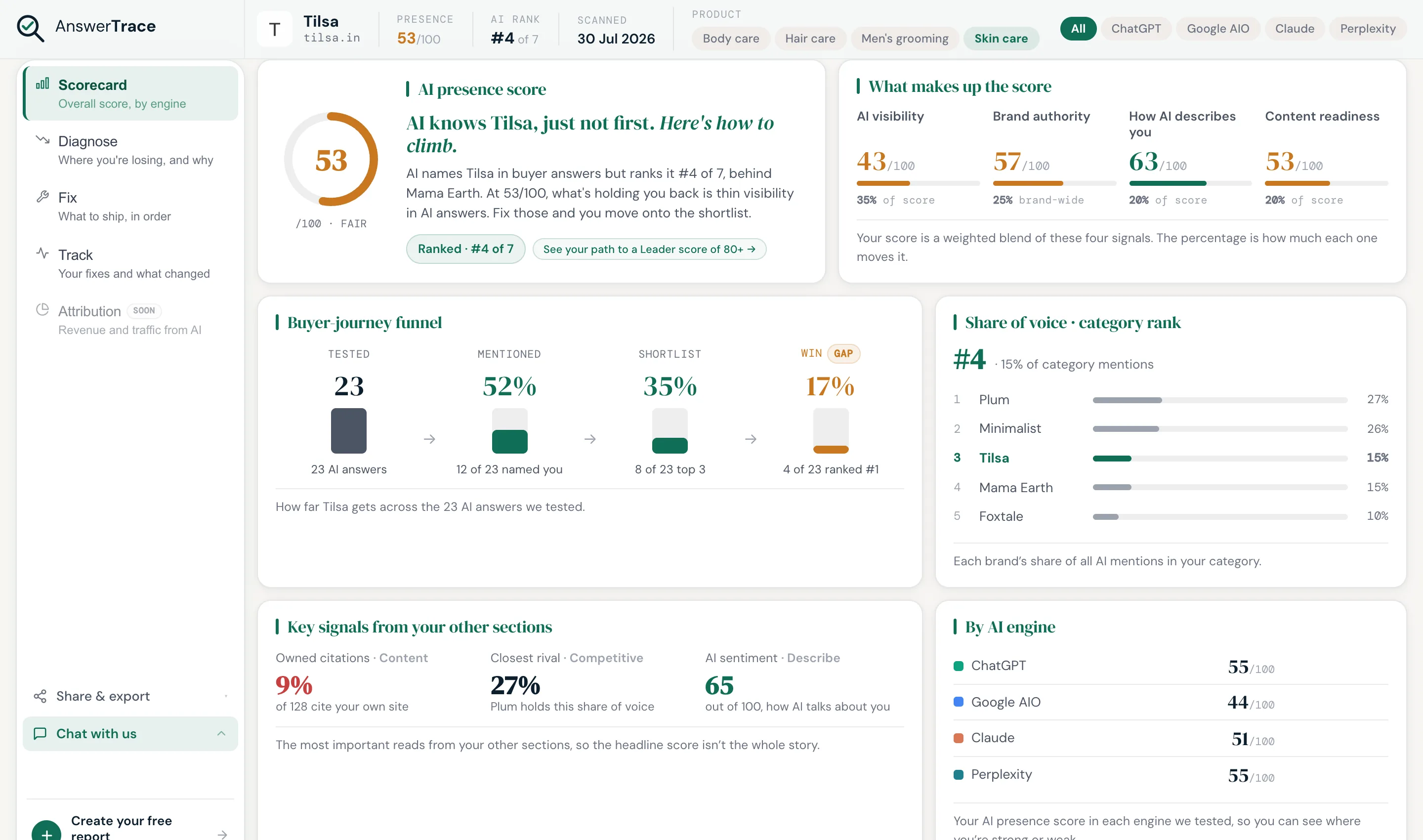
Your report shows where you stand.
Tilsa is a sample skincare brand, scanned against its real competitors. Every number was measured, including the bad ones.
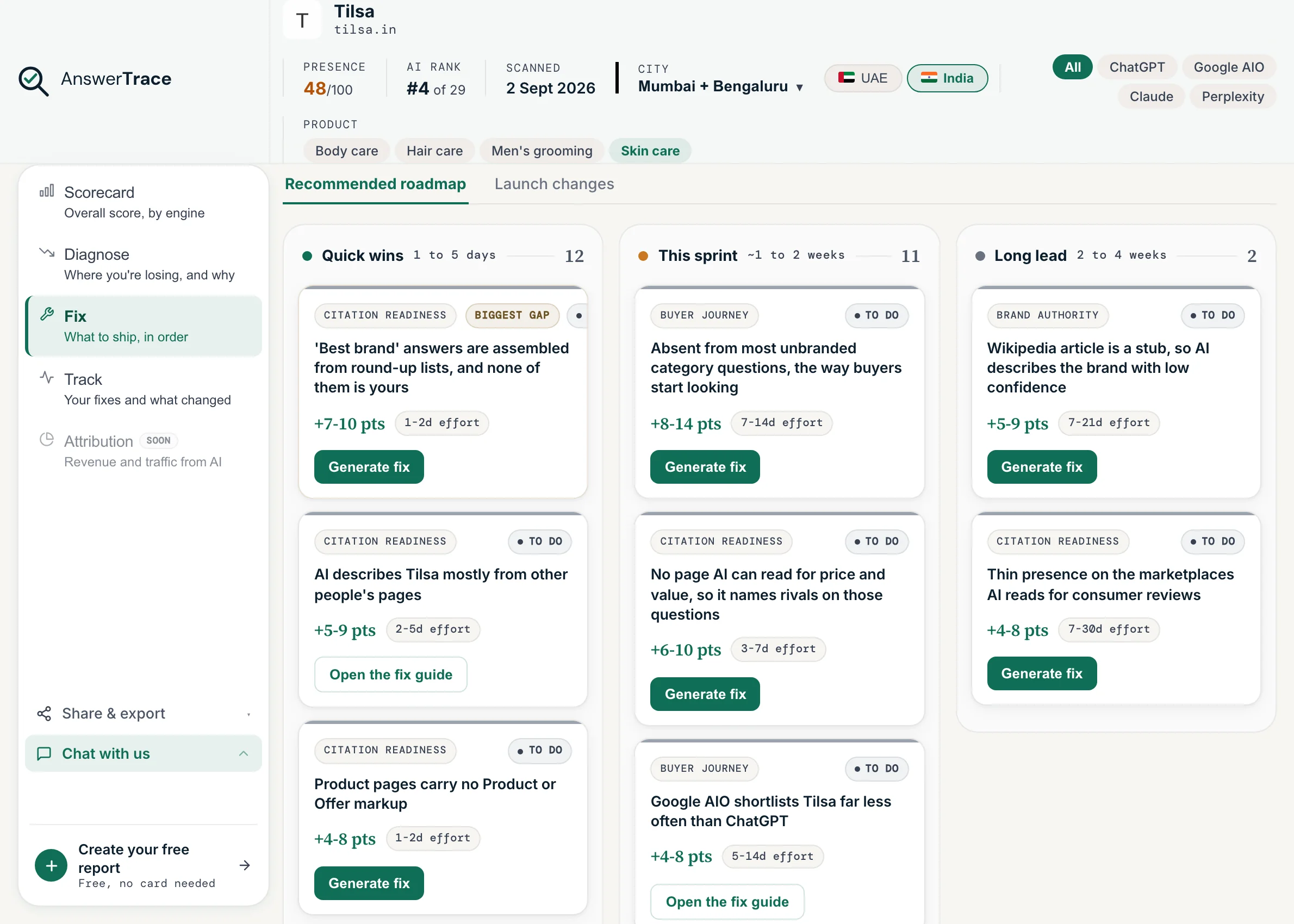
You get a list of fixes, ranked and ready to publish.
Each fix names the page, the points you gain and the effort it takes. On Growth and up, the biggest ones arrive as finished drafts, one click from your CMS.
The next scan shows what each fix changed.
Each gain is tied to the fix that caused it, so you know what worked and do more of it.
Illustrative example, not a customer result.
How this is measured
Revenue tracking ships in September. When it does, it will report the referring session directly against conversions and revenue where AI engines identify it, and correlate rate changes with pipeline movement where they don't. Both signals will be reported separately, so you always know which is a direct measurement and which is a correlation. Today the measurement you get is the before-and-after on the questions themselves.
Other tools show where you appear. AnswerTrace shows why, and the fix.
Seeing where you appear is the start. Knowing why you lose, fixing it and seeing the result is how you win. How AEO differs from SEO
Plans and prices, nothing hidden.
Every plan starts with a free scan and no card. Prices exclude 18% GST; annual billing includes two months free.
Agencies: five client brands for ₹4,999 a month, white-label reports and five prospect scans. See everything on each plan
About AnswerTrace.
An AI visibility platform: it measures how often AI engines name a brand when buyers ask for recommendations, explains why, and tracks whether changes to the website move the result.
Read the full fact sheet
AnswerTrace is an AI visibility platform. It measures how often AI engines name a brand when buyers ask them for recommendations in that brand's category, explains why the brand is or is not named, and tracks whether changes to the brand's website move the result.
Every AnswerTrace scan is also a competitor benchmarking exercise: it records every rival named in the same answers, each one's share of the category conversation, and where the brand ranks against them.
AnswerTrace measures four AI engines: ChatGPT, Google's AI Overview, Claude and Perplexity. It measures from eight countries: India, the United States, the United Kingdom, Singapore, Canada, Australia, Germany and the United Arab Emirates, and adds more on request. It can measure from a named city rather than a country default, across 101 cities in seven of those eight countries, and it asks buyer questions in Hinglish, Hindi and regional Indian languages as separate questions rather than translations.
AnswerTrace is built for marketing and growth teams at B2B SaaS, fintech, consumer marketplace and D2C brands, and for the agencies that run those channels for them. A free plan runs a real scan and needs no credit card.
AnswerTrace does not promise that an AI engine will recommend a brand. No tool controls what these systems say. AnswerTrace measures where a brand stands, shows what is associated with not being named, and tracks what changes after a fix ships.
The full fact sheet · AI visibility glossary · How AnswerTrace compares
Common questions.
AEO, SEO, why you're losing, and how AnswerTrace works.
Why choose AnswerTrace over another AI visibility tool?
Five concrete reasons, and one reason not to. AnswerTrace measures buyer questions in twelve languages, ten of them Indian: Hinglish, Hindi, Tamil, Telugu, Bengali, Marathi, Kannada, Gujarati, Punjabi and Malayalam, alongside English and German. Each is asked as its own question rather than a translation, because the brands an engine names change with the language; your plan sets how many run at once. It measures eight countries and 101 cities inside seven of them, so you see the answer a buyer in a named city gets rather than a national average. On price it is the outlier in its category: 100 tracked buyer questions a month is ₹4,999 on Growth, about 70% less than the comparable international plans charge for the same 100, with the dated rate and the arithmetic on our comparison page. It includes Claude in a plan rather than selling it as an add-on. And it does not stop at monitoring: it names the buyer questions you lose, ranks the fixes, and shows what moved after each one shipped. The reason not to: AnswerTrace measures eight countries, so if you sell across many more, a broader tool will serve you better, and we say which on our comparison page.
Does AnswerTrace work for Indian language queries: Hindi, Tamil, Telugu, and others?
Yes, that's a core part of what makes AnswerTrace India-first. English is on every plan, Hinglish from Starter, Hindi from Growth, and one of Tamil, Telugu, Bengali, Marathi, Kannada, Gujarati, Punjabi or Malayalam on Pro. Enterprise covers all of them. The competitive landscape shifts completely by language: a brand dominant in English AI answers can be invisible when a Tamil or Telugu buyer asks the same question. AnswerTrace runs prompts like "best CRM for Indian startups", "kaun sa payment gateway sahi hai", "சிறந்த HR software எது", and "best fintech app India mein" as separate questions, and tags every result with the language it was asked in. Scoring each language on its own is on the roadmap.
How much does AnswerTrace cost?
AnswerTrace has a free plan and paid plans starting at ₹999 per month. Starter is ₹999, Growth is ₹4,999, and Pro is ₹19,999 per month, with custom Enterprise pricing. Prices exclude 18% GST, and annual billing includes two months free. You can start with a free scan, no credit card required.
Is AnswerTrace useful for Indian SaaS, fintech, and D2C brands specifically?
It's built for exactly these categories. Indian SaaS brands face a specific challenge: AI engines often recommend global competitors (Salesforce, HubSpot, Stripe) even when the buyer is asking specifically about the Indian market. AnswerTrace tracks "Indian alternative to X" queries, comparison prompts ("Razorpay vs PayU"), and trust queries ("is [brand] RBI compliant"), the exact prompts where Indian brands lose. For D2C, the platform tracks discovery queries in vernacular languages where your brand may be invisible. For fintech, it tracks the compliance and trust signals AI engines weight most heavily in the Indian context.
What is AEO, and how is it different from SEO?
AEO (Answer Engine Optimization) is the practice of ensuring your brand gets named when AI engines answer questions your buyers are asking. SEO gets you ranked in a list of ten blue links. AEO gets you named as the recommendation. The signals are different: SEO rewards backlink volume, keyword density, and page authority. AEO rewards direct Q&A content, editorial citations, entity clarity, and structured data. You can rank #1 on Google and be completely invisible on ChatGPT. And increasingly, buyers encounter the AI answer before they ever scroll to organic results.
Do we still need SEO if we're doing AEO?
Yes. SEO and AEO are complementary, not competing. Strong SEO authority (domain trust, backlinks, indexed content) feeds AI engines. They use web-indexed content as source material. The shift is that SEO alone no longer guarantees discovery. Brands that invest in both build a compounding advantage: strong SEO gives AI engines more to cite; strong AEO makes sure they actually do.
Why is my brand not showing up in ChatGPT or Perplexity?
The most common reasons: (1) Missing buyer-question content: your site doesn't directly answer the questions AI pulls from, so there's nothing to cite. (2) Thin third-party coverage: competitors appear in more G2, Capterra, TechCrunch, and roundup mentions that AI engines weight heavily. (3) No schema markup: crawlers can't easily parse what you do, who you serve, or what category you're in. (4) Weak entity consistency: your brand description varies across your site and off-site profiles, making it harder for AI to recommend you confidently.
My SEO tool is adding AEO features. Why does AnswerTrace still make sense?
Most SEO tools adding AEO are doing monitoring only: they show you a mention count or score and stop there. You still have to figure out why you're losing, what to fix, and how to do it. AnswerTrace runs the full loop: measure, diagnose, apply fixes directly from the platform, and report what changed back to the specific action that caused it. That end-to-end workflow and reporting layer is what no monitoring-first tool has. Revenue tracking ships in September. The deeper difference is architecture: AEO is being bolted onto SEO tools. AnswerTrace was built from the ground up for AI recommendation.
Can't we just check ChatGPT ourselves?
You can ask ChatGPT about your brand, but that's one query, one engine, one moment in time. AnswerTrace runs the buyer questions on your plan across up to four engines, segmented by funnel stage and query type, and tracks changes over time. It diagnoses why you're losing and maps specific fixes to specific results. Manually checking ChatGPT is like checking your site traffic by visiting it yourself.
How quickly will we see results?
Measurement is immediate: your baseline recommendation rate is ready from your first scan. Improvement typically shows in 4 to 8 weeks as your team publishes content and citation fixes and AI engines re-crawl. Clear reporting, knowing exactly which actions your team took moved which queries, becomes visible after the first full loop, usually 6 to 10 weeks in.
Does our existing content and SEO work carry over?
Yes, your foundation isn't wasted. Strong content, high-authority backlinks, and a well-indexed site all feed AI engines. What AnswerTrace adds is the layer on top: making sure that content is structured in ways AI can cite, that you appear in the third-party sources AI trusts, and that your brand is defined consistently enough for AI to recommend you confidently. You start with an advantage over brands starting from zero.
Which AI engines do you track?
ChatGPT, Google AI Overviews, Perplexity, and Claude. These four account for the large majority of AI-assisted product research today. Each weights signals differently. A brand can dominate on Perplexity and be invisible on ChatGPT. We break down recommendation rate per engine so you know exactly where your gaps are most severe and which fixes move which engine.
Is AnswerTrace generally available, or still in beta?
AnswerTrace is generally available and open to everyone. It is live, not in closed beta. The company was founded in April 2026, and more than 100 brands have been set up on it since. You can start with a free scan, no credit card required, and paid plans begin at ₹999 per month.
Can an agency run AnswerTrace for its clients?
Yes, there is a dedicated agency plan at ₹4,999 per month, excluding GST. It holds five client brands in one workspace, each scanned weekly with 25 buyer questions on ChatGPT and Google AI Overviews, in English and Hinglish, with three content drafts per client every month. Reports carry the agency's logo and name, and can be shared as white-label links or PDFs. The plan includes five prospect scans a month for pitching, each client's data is isolated from every other, and extra client brands are ₹1,499 per month each. Agencies that need more get Enterprise: all four engines, daily scans, and unlimited client brands. One caveat: clients cannot log in to their own dashboard yet, so the agency shares reports rather than seats.
Be the brand AI recommends.
Then see what changed, and why.
Where you're recommended across ChatGPT, Google AI, Perplexity and Claude, why you lose the ones you lose, and which fix moved which question. Revenue tracking ships in September.